No gateway sprawl
One Apinizer API/AI Gateway runtime — not three (REST + WebSocket + AI) running side-by-side, eating cluster resources.
One platform for every API request — including agents.
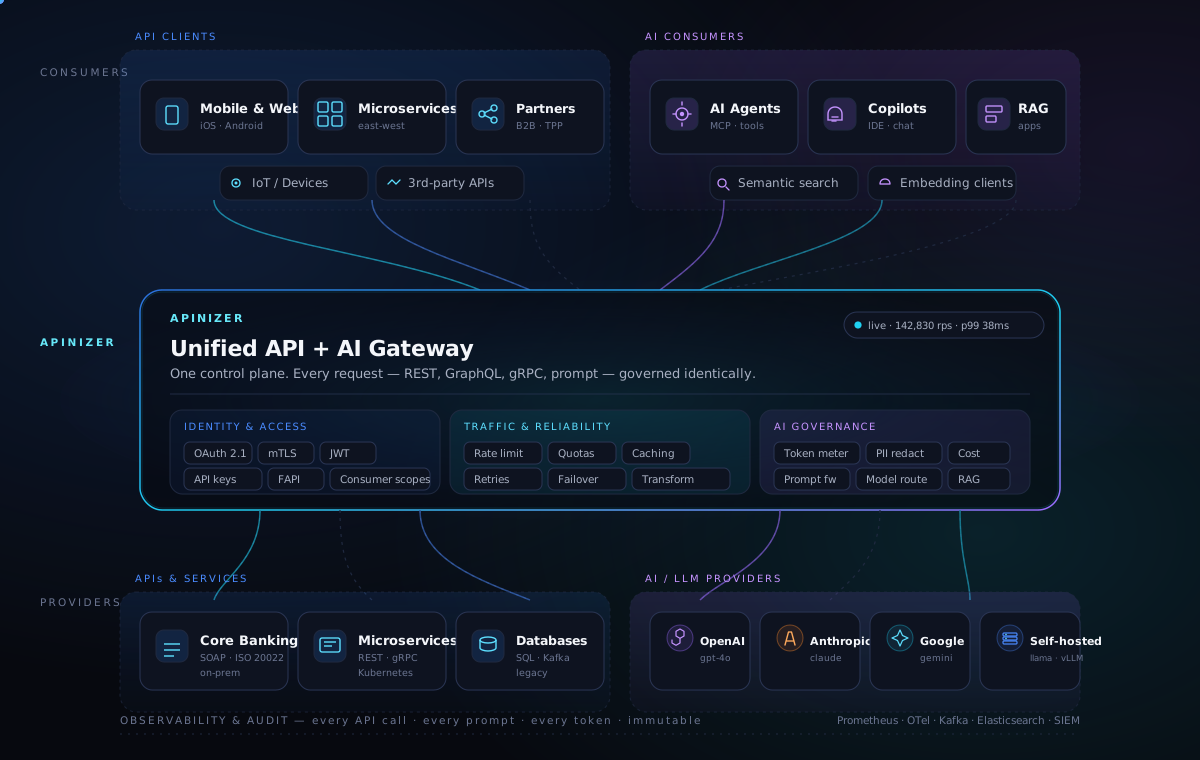
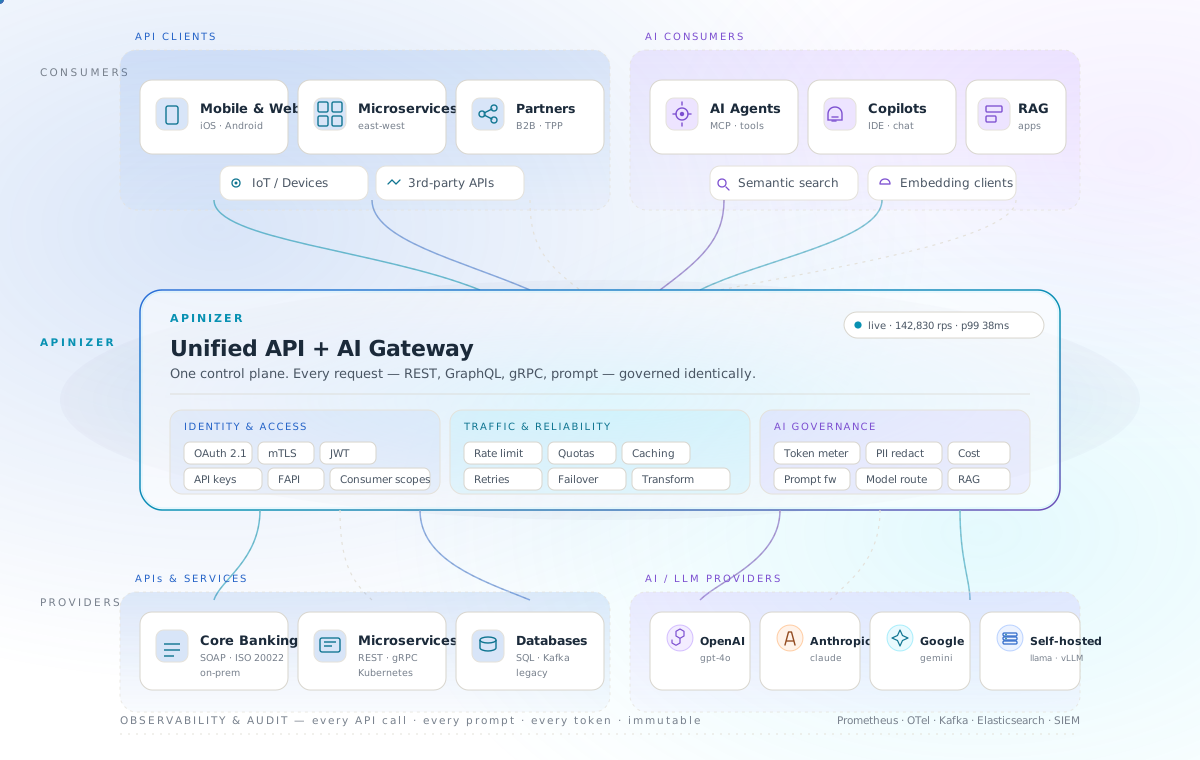
Apinizer is the unified API & AI Gateway platform. HTTP, gRPC, SOAP, WebSocket, GraphQL — alongside LLM, MCP, and agent-to-agent traffic — through one runtime on your own server. Policies in code. Audit and encryption built in.
Trusted by 100+ organizations across banking, government, and defense
The unified gateway
Banks running WSDL services next to gRPC, GraphQL, and AI traffic don't need a separate gateway per protocol. The same Worker, the same policy pipeline, the same audit aspect — across every era of API.
One Worker — every protocol
SOAP 1.1 / 1.2
WSDL primed at deploy, WS-Security, WS-Addressing
WSDL imports
Auto-convert to OpenAPI; expose as REST or gRPC
HTTP / 1.1
Keep-alive, chunked, content compression
HTTP / 2
Multiplexing, server push, binary framing
REST
Stateless, HATEOAS, content negotiation, versioning
GraphQL
Reverse proxy, query / mutation / subscription
gRPC
Protocol Buffers, unary + bidi streams over HTTP/2
WebSocket
RFC 6455, binary + text frames, WSS (TLS)
LLM (OpenAI)
Multi-LLM routing across a 26-provider catalog
MCP
Model Context Protocol — expose REST / SOAP APIs as tools
A2A
Agent-to-agent auth + observability + audit
One Apinizer API/AI Gateway runtime — not three (REST + WebSocket + AI) running side-by-side, eating cluster resources.
WSDL calls, gRPC streams, and LLM prompts all land in the same Elasticsearch index, queryable side-by-side.
Three-tier (System / Project / Team) governs SOAP-as-REST proxies, AI routes, and the Manager UI uniformly.
Many teams, one platform
Apinizer's Project model lets unlimited teams run their own work side-by-side under shared infrastructure. Each Project has its own URL prefix, its own member list, and its own scope — proxies, policies, connections, credentials, variables, task flows. Server-side enforcement, not just UI hiding.
/<project>/...ProjectAuthAspect rejects cross-project access at the framework layerProject switcher
⌘K/payments-core
Owner
Full control of the project — read, write, deploy, and member management.
Manager
Read, write, and deploy. No member management — that stays with the Owner.
Developer
Read and write the project's proxies, policies, connections — no deploy.
Viewer
Read-only — useful for auditors, partner teams, and read-only integrations.
Many environments, one console
Each Environment is a Kubernetes Namespace — isolated CPU, RAM, and network. The same proxy can run version 1.0 in PROD-EU and version 1.1 in PROD-TR at the same time. No second Manager. No duplicate configuration.
dev
DEPLOYEDstaging
DEPLOYINGprod-eu
DEPLOYEDprod-tr
DEPLOYEDprod-air
IDLEperf-lab
DEPLOYED1:1 K8s namespace mapping
Each environment isolates CPU, RAM, network.
TEST or PRODUCTION
Two types drive licensing and resource allocation.
HTTP, HTTPS, gRPC, WS
Four protocol modes per environment.
Per-environment versions
Same proxy, different version, side-by-side.
Variables scope by env
${var} resolves to a different value in PROD vs TEST.
Connections scope by env
Database / Kafka / SMTP credentials per environment.
Hybrid by design
Some environments live in the cluster Apinizer manages for you. Others run on your own Kubernetes — region-local, sovereign, or air-gapped. Same Manager, same audit trail, same identity, same permissions. The only difference operators see is a small Managed or Remote badge.
The Apinizer API/AI Gateway runs in the cluster Apinizer operates next to the Manager. Fast iteration, predictable scale, hands-off operations. Ideal for TEST and STAGING.
The Apinizer API/AI Gateway runs on your Kubernetes — EKS, AKS, GKE, OpenShift, Tanzu, RKE2, or on-prem. Sovereign, region-local, air-gapped — the data plane stays where regulation requires it.
apiServerUrl + service account token to connect@SecretData)Real hybrid topology
TEST managed for fast iteration · STAGING remote on AWS EKS in eu-west-1 · PROD remote on on-prem OpenShift, air-gapped · DR remote on Azure AKS in another region. One Manager. One audit trail. One permission model.
The same gateway that runs your REST APIs now governs every AI request your applications make. One audit trail. One permission model. One place to set the rules.
Token tracking, cost ceilings, leak prevention. Per user, per model, per window.
A 26-provider, 185-model catalog behind one OpenAI-compatible facade. Switch models without code changes.
Turn existing REST and SOAP APIs into MCP tools, or pass through to external servers. Tool-level access control, schema drift detection, agent task audit.
Drop token spend on repeat prompts. Decode encoded payloads, then block injection and jailbreaks. Mask TCKN, IBAN, and card data — even mid-stream — and restore it for authorized roles only.
26 LLM providers, 185 models — one OpenAI-compatible facade
The Apinizer suite
API Gateway and AI Gateway are the data plane. Identity, Analytics, Portal, Designer, Creator, Integrator, Cache, and Monitoring round out the platform — all configured from the API Manager.
Worker — data plane
Apinizer API/AI Gateway — multi-protocol data plane for HTTP, gRPC, WebSocket, SOAP, GraphQL, and AI traffic on one Java 25 runtime. 50+ policies for auth, traffic, transformation, and observability — out of the box.
AI Gateway — agentic plane
Token budgets, exact and semantic cache, prompt firewalls, RAG on your own VectorDB, and multi-LLM routing — governing every LLM, MCP, and agent request on the runtime that already runs your REST APIs.
Identity Manager
OIDC, OAuth 2.0, JWT, JOSE — plus mTLS, SAML, LDAP / AD, and database-backed federation. One identity surface for every Apinizer API and AI request, with three-tier permissions and Repository-layer audit.
API Portal
Open the front door for developers, partners, and AI agents. Stand up as many portals as you need — Public, Internal, Partner, Agents — each branded as your own. No own database, fully customizable, MCP-ready, live in regulated environments.
Analytics Engine
Watch every API call. Ship the log everywhere. Answer in seconds. Async traffic capture, fan-out to nine destinations in parallel, dashboards and tracing operators actually use, and anomaly detection with EMA + Bollinger Band — backed by Elasticsearch.
API Designer
Design the API. Ship the proxy. One click apart. OpenAPI 3, Swagger 2, and WSDL editing — with a one-click path from spec to a live, governed API on the same gateway, and instant documentation in every format your team needs.
API Creator — three ways to skip the microservice
Apinizer API Creator — three ways to ship an endpoint without a microservice. DB to API turns SQL into REST. Mock API gives frontends real-shaped responses with auth. Script to API runs JavaScript or Groovy as an endpoint.
API Integrator · Task Flow Manager
Connect anything to anything. Without writing the integration. Eighteen task types on one drag-and-drop canvas, chained with output keys and JSON Path, fired by cron, HTTP, or another flow — and governed by the same audit and identity stack as the gateway.
Cache
Apinizer Cache is a two-tier cache — a local in-pod tier inside every gateway, a Hazelcast cluster on Kubernetes for the distributed tier. Twelve first-party cache scopes, atomic invalidation on redeploy, throttle and quota on the same cluster.
Monitoring
Apinizer Monitoring — uptime probes from your regions, anomaly detection with EMA and Bollinger bands, ten platform alert triggers ready on day one, and severity-aware action chains to Slack, Microsoft Teams, ServiceNow, email, webhook, and more.
Deploy anywhere
One platform, four runtimes. Apinizer ships the same artefacts to every target — no fork, no separate edition. Whether your standard is enterprise Kubernetes, Red Hat OpenShift, VMware Tanzu, or traditional virtual machines, the gateway, manager, and APIops surface stay identical.
Vanilla, EKS, AKS, GKE, RKE2.
Helm charts · operator-managed · hot deploy without dropped sockets.
Red Hat enterprise clusters.
SCC-aware manifests · OpenShift routes · air-gapped registries.
VMware-native Kubernetes.
TKGm / TKGs supported · vSphere CSI · TMC observability hooks.
RHEL, CentOS, Ubuntu, Windows Server.
systemd unit · zero container runtime needed · same artefacts as K8s.
Mix and match — one platform
A single Apinizer environment can blend runtimes. Some workers on Kubernetes, others on legacy virtual machines, a third group on OpenShift in another data centre — all under the same Manager, the same identity, the same audit trail. Move at your own pace; the platform doesn't force a rebuild.
On-prem · Sovereign cloud · Public cloud · Air-gapped — same binary
Developer experience
Policies as classes, scripts you can drop in today. Apinizer's surface area is small enough to read end-to-end and explicit enough to review.
# Deploy a proxy from CI — references are by name, not internal ID$ apinizer apply -f orders-api.yaml> proxy: orders-api environment: prod> status: deployed revision: 42Organizations on Apinizer
Banks, ministries, defense — across regulated industries.
Native protocols
HTTP / HTTP/2 · REST · SOAP · gRPC · WebSocket · GraphQL.
Codified business invariants
Domain rules enforced by the platform — extend with your own custom plugins.
Latest release
Four-month cadence — only the latest major receives patches.
Industries
Audit, encrypted secrets, and three-tier access for the APIs that touch payments and identity.
Bilingual TR + EN, runs entirely on the customer's Kubernetes — no calls home.
Low-latency API tier in front of OSS / BSS, with hot deploy and async logging.
API tier in front of SCADA-adjacent systems, EMS, and partner billing — with anomaly detection and certificate watchdogs.
Quote, bind, and claim APIs that need versioning and observability without a rewrite.
Air-gapped or sovereign clusters with strict change control and zero-trust defaults — no calls home, rootless containers, and an audit trail you can present to oversight.
Built on the standards your team already runs
Apinizer is a JVM-native platform that fits where Java, Spring, and Kubernetes already live.
Runtime
Frontend & DX
Standards
Ready when you are
A 30-minute walkthrough of API Gateway, AI Gateway, Manager, Portal, and the rest of the suite — on a Kubernetes of your choice.